To a machine, a photo is just a bunch of pixels until it learns what it’s looking at. Tagging image data adds the critical context, helping AI models recognize objects, environments and details accurately.

Image tagging services offer scale and speed to train production-ready systems. Maintaining dataset integrity depends on clear guidelines, rigorous quality assurance and expert oversight.
What is image tagging?
Image tagging attaches descriptive metadata or keywords to a photo based on a set list of terms or taxonomy. For ecommerce catalogs, teams tag visual assets with attributes like: “Category: Apparel,” “Subcategory: Shirt,” “Fabric: Denim,” “Color: Blue.” These tags power site navigation, search filters and personalized product recommendation engines.
In industrial settings, contributors tag photos to classify workplace conditions and safety gear (e.g., PPE: Compliant) for regulatory oversight and reporting.
The workflow establishes the ground truth data for machine learning (ML). Every detail must be accurate as subtle errors confuse the system and lead to poor predictions.
Image tagging vs. image annotation
While often used interchangeably, image tagging is a subset of the broader image annotation process. Annotation is the general process of marking up visual files for a model to understand what it’s about, what’s in them and where.
Tagging refers specifically to attaching one or more keywords or categories to the entire image. It’s used for broad categorization, fast filtering, organizing datasets and automated search indexing.
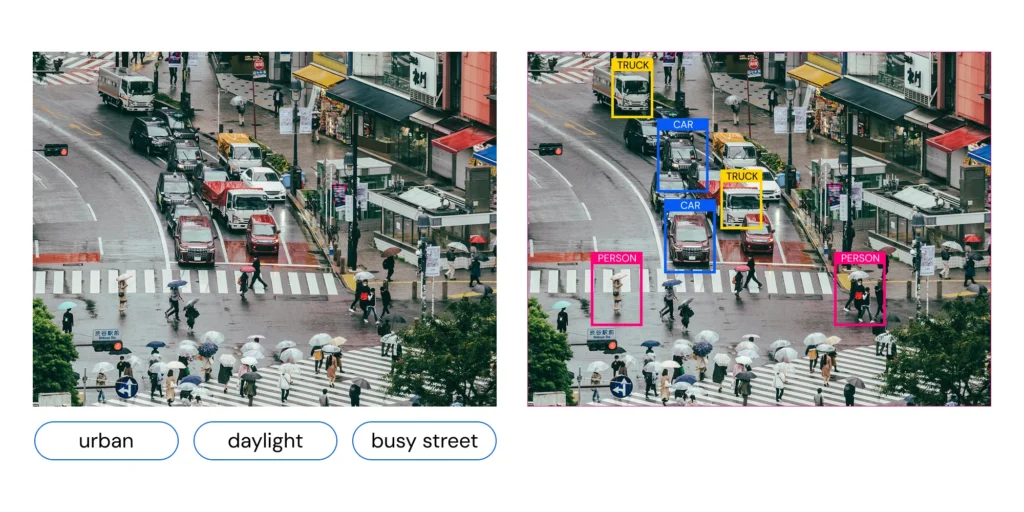
Consider a photo of a city street. Image tagging applies high-level attributes like “urban,” “daytime” and “vehicles present” so a classification model learns to recognize the overall environment.
For that same file, annotation could include drawing 3D bounding boxes around individual vehicles, line traces along lane markers and masks over pedestrians so that an object detection or segmentation model could count, locate and measure each element.
Most production pipelines use both methods sequentially: tagging visual files to filter and categorize incoming data, clearing the path for detailed spatial annotation downstream.
Powering computer vision models
Beyond basic site search, image tagging creates the foundational training data for computer vision. This branch of AI enables machines to interpret visual information. Teams structure this training data across three main use cases: image classification, facial attribute mapping and scene recognition. Each follows a different labeling process.
To train image classification models, workers assign tags representing specific items, retail products or structural defects to teach systems to identify whether a category exists anywhere in the frame.
For facial analysis systems, annotators record demographic attributes, facial expressions and lighting conditions as metadata. This work involves sensitive personal data, so strict privacy safeguards, including consent forms, access controls and data retention limits govern every stage of data collection and processing.
To enable scene classification, teams capture the broader environmental context by labeling overall background settings, location (e.g., indoor/outdoor) and weather conditions.
Broad coverage across all three areas keeps datasets balanced. As NIST testing proves, computer vision models easily stumble over minor shifts in lighting, camera design or image clarity. Detailed attribute tagging surfaces these gaps early, making it easier to track accuracy across diverse demographics and environments.
Balancing VLM auto-tagging with human review
Today, automated pre-labeling is standard across enterprise operations to reduce processing time and unit costs. Historically, auto-taggers relied strictly on preconfigured label lists. Modern pipelines increasingly use zero-shot vision-language models (VLMs) and open vocabulary auto-taggers, allowing teams to auto-label complex visual scenes using natural language prompts.
Despite these advances, off-the-shelf models still struggle with specialized categories. Identifying proprietary products, domain-specific terminology or rare manufacturing defects still requires human-labeled examples first. Managing metadata separately from raw image assets is also critical to ensure version control and searchability without altering original visual files.
The most effective strategy deploys a hybrid approach: leveraging automated pre-tagging for high volume, predictable files and relying on human reviewers to establish taxonomies, resolve ambiguous labels and continuously audit model accuracy.
Frameworks for scoping an image tagging pipeline
Setting explicit dataset parameters upfront helps prevent operational bottlenecks, model degradation and deployment delays. Evaluating these four operational criteria helps establish the right pipeline strategy: taxonomy alignment, dataset scale, domain specialization and automation boundaries.
Taxonomy alignment determines whether a model requires broad category coverage for fast search indexing or high-precision multi-label tagging for fine-grained classification.
Dataset scale and delivery cadence dictate whether a project is a static, one-off batch of thousands of baseline images or a continuous streaming queue of millions monthly.
Task complexity dictates the level of domain expertise required. While generalist contributors easily handle everyday objects and road scenes, specialized fields like medical imaging, industrial defect detection or satellite telemetry demand subject matter experts.
Establishing explicit confidence thresholds ensures that automated pre-labelers seamlessly hand off complex edge cases to human review queues.
Sourcing models: Balancing security, throughput and complexity
When outsourcing image tagging, sourcing models should align with data privacy constraints, task nuance and security compliance.
Open crowdsourcing networks distribute tasks across large pools of contributors. This setup typically supports fast turnaround times for public, non-sensitive data, though it often requires automated checks to manage dataset quality.
Vetted managed workforces are commonly used for standard enterprise workflows. In this model, annotators complete skill assessments before joining queues to support data consistency across incoming batches.
When handling sensitive visual assets, such as personal identifiers, health records or proprietary designs, organizations often rely on dedicated teams. These teams operate under strict access controls and project governance designed to align with privacy standards.
Protecting dataset integrity through QA mechanics
Regardless of how a dataset is sourced, quality control determines how well a machine learning model actually learns. A layered quality assurance strategy catches errors early by combining consensus labeling, benchmark checks and spot audits.
In consensus review, identical images are sent to multiple annotators at the same time. If their tags do not match, a senior reviewer steps in to resolve the difference and clear up confusing guidelines before mistakes spread across the dataset.
To track accuracy over time, teams mix pre-labeled benchmark images directly into active work queues. Because annotators do not know which images are tests, this setup measures real-time performance and catches drops in quality early.
Quality managers then spot-check completed batches to catch broad patterns of error, applying extra review rounds for safety-critical fields like autonomous driving or medical imaging.
Regulatory compliance and dataset governance
Beyond model accuracy, data quality directly impacts legal compliance under emerging global AI standards. Under Article 10 of the EU AI Act, organizations building high-risk AI systems face strict regulatory mandates around dataset governance, data cleaning and bias mitigation.
In parallel, standards like ISO/IEC 5259 establish international benchmarks for AI data quality, setting measurable requirements for completeness, accuracy and lineage tracking across the entire machine learning lifecycle.
Structuring high quality datasets for AI
Building reliable AI involves a deliberate pipeline strategy that balances modern pre-labeling automation with structured human expertise. By establishing clear scoping parameters, deploying layered quality controls and adhering to emerging global compliance standards, organizations can build robust visual datasets that support accurate models and meet evolving regulatory expectations.


